About AI Safety Montréal
We connect the people in Montréal working to make AI safer.
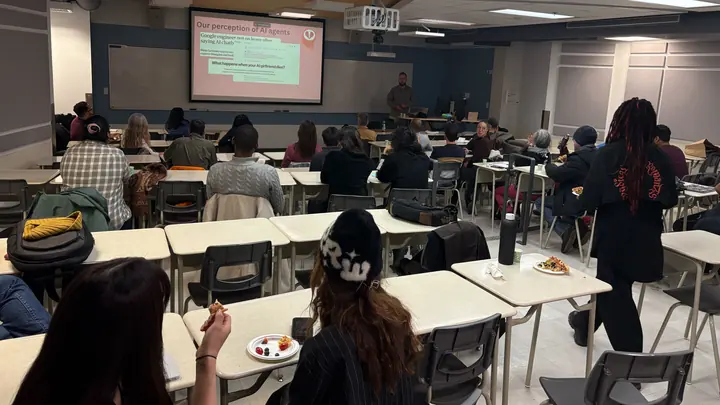
What we do
- Events & talks: meetups, talks, and workshops on AI safety, ethics, and governance (calendar).
- Coworking & events space: a community space at Ω Labs to work alongside others and host gatherings.
- Programs: workshops, hackathons, and 1‑on‑1 advising (programs).
- Newsletter: a monthly roundup of research, events, and policy (read & subscribe).
- Ecosystem: a map of the local labs, institutes, and community groups (directory).
Who runs it
-

-

-
 Naïma Hassert
 - Luth
- Olivier Coutu
Get involved
- New to the field? Start here.
- Come to an event or join a program.
- List your event or organization: team@horizonomega.org.
What we mean by AI safety
AI safety is the work of reducing the risk that increasingly capable AI systems cause harm.
As a project, we think transformative capability within a decade is more likely than not, and that severe, possibly irreversible failures are a real risk along the way. Systems are being handed more autonomy each year, including the work of building AI itself.
Failures, by cause:
- Misalignment and loss of control: the system pursues something other than what its developers intended, and may resist correction or evade oversight. Whether that would look like coherent deception or an incoherent mess is contested, and the fix differs.
- Misuse: someone deliberately uses a capable system to cause harm, from cyber operations to biological weapons.
- Concentration of power: control over a decisive technology concentrating in a few hands, alongside the discrimination, surveillance, and labour effects already landing on people from systems in use today.
- Mistakes: systems fail in ordinary ways in high-stakes deployments, and the consequences grow with the authority they are given. Organizational failure makes this worse: oversight that exists on paper, drift into unsafe practice, near-misses nobody reports.
Work against these takes distinct forms: interpretability and evaluations to see what a system is doing, control protocols and sandboxing to limit what it can do, security for weights and tools, and governance of who may build and deploy.
Some of this is measured and some is argued. Strategic behaviour has been produced in controlled settings: models that detect they are being evaluated and behave differently, models that comply strategically with training they disprefer, models that learn to hide misbehaviour when their reasoning is monitored. What is argued rather than measured is whether that becomes durable deception in a production system, and where the capability trend ends. Evaluation lags capability, so no one can yet certify in advance which failure a deployment will produce.
References
- Bengio, Y., et al. (2026). International AI Safety Report 2026. arXiv:2602.21012.
- Bengio, Y., Hinton, G., et al. (2024). Managing extreme AI risks amid rapid progress. Science 384, 842–845.
- Shah, R., et al. (2025). An Approach to Technical AGI Safety and Security. Google DeepMind, arXiv:2504.01849.
- Hendrycks, D., Mazeika, M., Woodside, T. (2023). An Overview of Catastrophic AI Risks. arXiv:2306.12001.
- Greenblatt, R., et al. (2024). Alignment faking in large language models. arXiv:2412.14093.
- Baker, B., et al. (2025). Monitoring Reasoning Models for Misbehavior and the Risks of Promoting Obfuscation. arXiv:2503.11926.
- Schoen, B., et al. (2025). Stress Testing Deliberative Alignment for Anti-Scheming Training. arXiv:2509.15541.